
Most of us will experience pigmentation at some point, it’s inevitable with sun exposure. In this blog I want to talk to you about what pigmentation is, what causes it, how to prevent too much damage and of course what your options are when it comes to treating it.
What is Pigmentation?
Pigmentation refers to the colouring of your skin, eyes and hair. It is determined by the amount of melanin in your body. There are two types of melanin;
- Eumelanin: Brown and black pigments which are found in the skin, hair, and eyes.
- Pheomelanin: Yellow and red pigments found in the skin and hair, particularly in people with lighter skin and red hair.
The amount and type of melanin you have will determine your skin colour, eye colour, and hair colour.
The purpose of pigmentation
Pigmentation is a vital factor in protecting your skin from ultraviolet (UV) radiation from the sun. The melanin absorbs UV radiation and dissipates it as heat, which reduces the risk of damage to your skin, premature ageing and skin cancer.
What is abnormal pigmentation?
There are two types of abnormal pigmentation;
- Hyperpigmentation: This occurs when there is an overproduction of melanin. It can result in darker skin patches.
- Hypopigmentation: Occurs when there is a reduction in melanin production, which results in lighter skin patches.
Effects of Hyperpigmentation;
If you are someone who is experiencing hyperpigmentation you may have;
- Sunspots (Age spots), which are dark areas on your skin caused by prolonged sun exposure.
- Melasma which are dark areas on the face that are often due to hormonal changes, such as during pregnancy or using birth control.
- Post-inflammatory hyperpigmentation are dark spots that appear after an injury to your skin. This may be in the form of acne, or a skin irritation.
Effects of Hypopigmentation;
If you think you have hypopigmentation you may see;
- Vitiligo, which is a condition where the immune system attacks the pigment-producing cells, in turn leading to white patches on the skin.
- Albinism is a genetic condition caused by little to no melanin production, which can lead to very light skin, hair, and eyes.
When is a good time to treat pigmentation?
Winter is the best time to treat your pigmentation concerns as the UV rays are less powerful in winter and any treatments you may have recommend reduced sun exposure, so it gives you the best opportunity to heal.
What treatments are best?
There are several ways you can treat your pigmentation and products you can use that specifically target the issues that come with it.
Some of my recommended treatments are;
- SQT
- Cryotherapy
- Microneedling
- Chemical peels
If you have smaller dark spots then cryotherapy is the quickest method, whereas if your pigmentation is larger I would recommend SQT.
What is SQT?
SQT Bio Microneedling is a revolutionary alternative treatment. Sponge spicules are a kind of siliceous bio microneedle that is only extracted from the freshwater sponge. They can stimulate the dermis of the skin and start skin surface microcirculation. It will also improve the capillary stoma-blocking phenomenon and also accelerate the natural exfoliation of the ageing cuticle. The benefits are immeasurable and proven to be a truly versatile alternative treatment.
Fascinatingly, it can be seen as a powder to the naked eye, although when under the microscope it represents a sharp rod crystal.
It is totally different to traditional microneedling
- No Aesthetic, no skin breakage, no bleeding
- Shortens the skin renewal cycle from 28 days to 7 days
- Achieves natural, safe and effective skin rejuvenation
- Flaking or peeling can be expected depending on the health of your skin and the level of penetration
- 2 types of treatment-one for resurfacing and one for rejuvenation
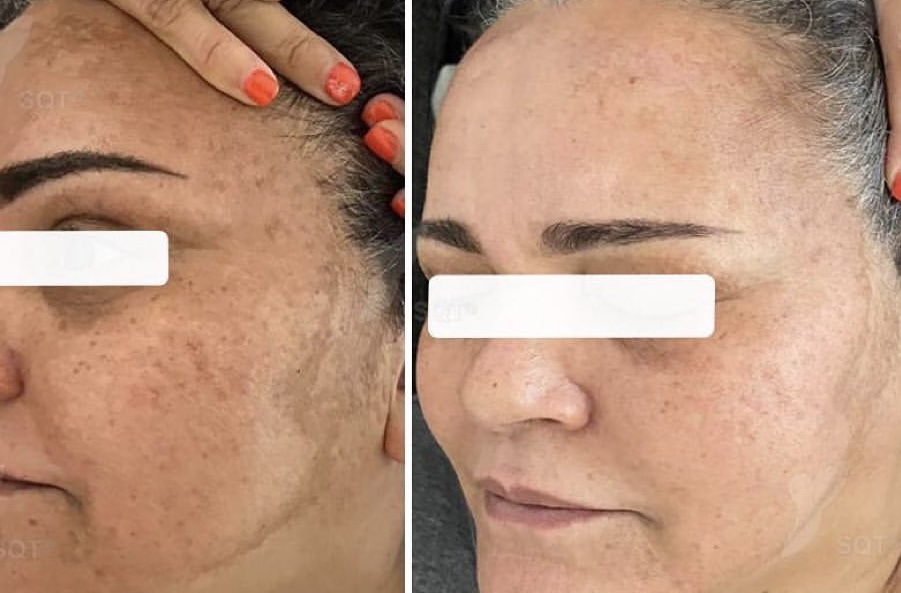
Before & after pic – is after just 2 sessions of SQT amazing for pigmentation. SQT is microneedling without needles!!
What is cryotherapy?
Cryotherapy is a medical treatment that involves using extreme cold to target and treat various conditions.
The CryoPen is an advanced cryotherapy innovation that is a fast, effective, safe and new solution for the removal of skin imperfections. Procedures typically last from 5 to 25 seconds. The CryoPen emits a fine jet of nitrous oxide under high pressure, which allows the clinician to work with millimetre precision. This destroys the tissue by freezing the inter-cellular fluid, forming ice shards and crystals which rupture the membrane, thereby destroying the cell. That means there will be no collateral damage to healthy tissue. It’s so incredibly accurate and practical.
Topical treatments for hyperpigmentation
If you want to treat hyperpigmentation, it means you want to treat dark spots, uneven skin tone, or other forms of discolouration on your skin. There are some topical treatments I would recommend;
- Retinoids – Come from Vitamin A which helps to increase skin cell turnover and promotes the shedding of pigmented cells.
- Vitamin C – it is a powerful antioxidant that helps to inhibit the production of melanin and will also brighten the skin.
- Niacinamide – helps to reduce the transfer of melanin to your skin cells, which will reduce the appearance of dark spots and help prevent new ones forming.
You see there are many products and treatments that can be used to tackle pigmentation, but knowing which one is right for you can be tricky. If you would like to know what treatment will be best to treat your pigmentation book in a consultation with me here.